Filament Flow
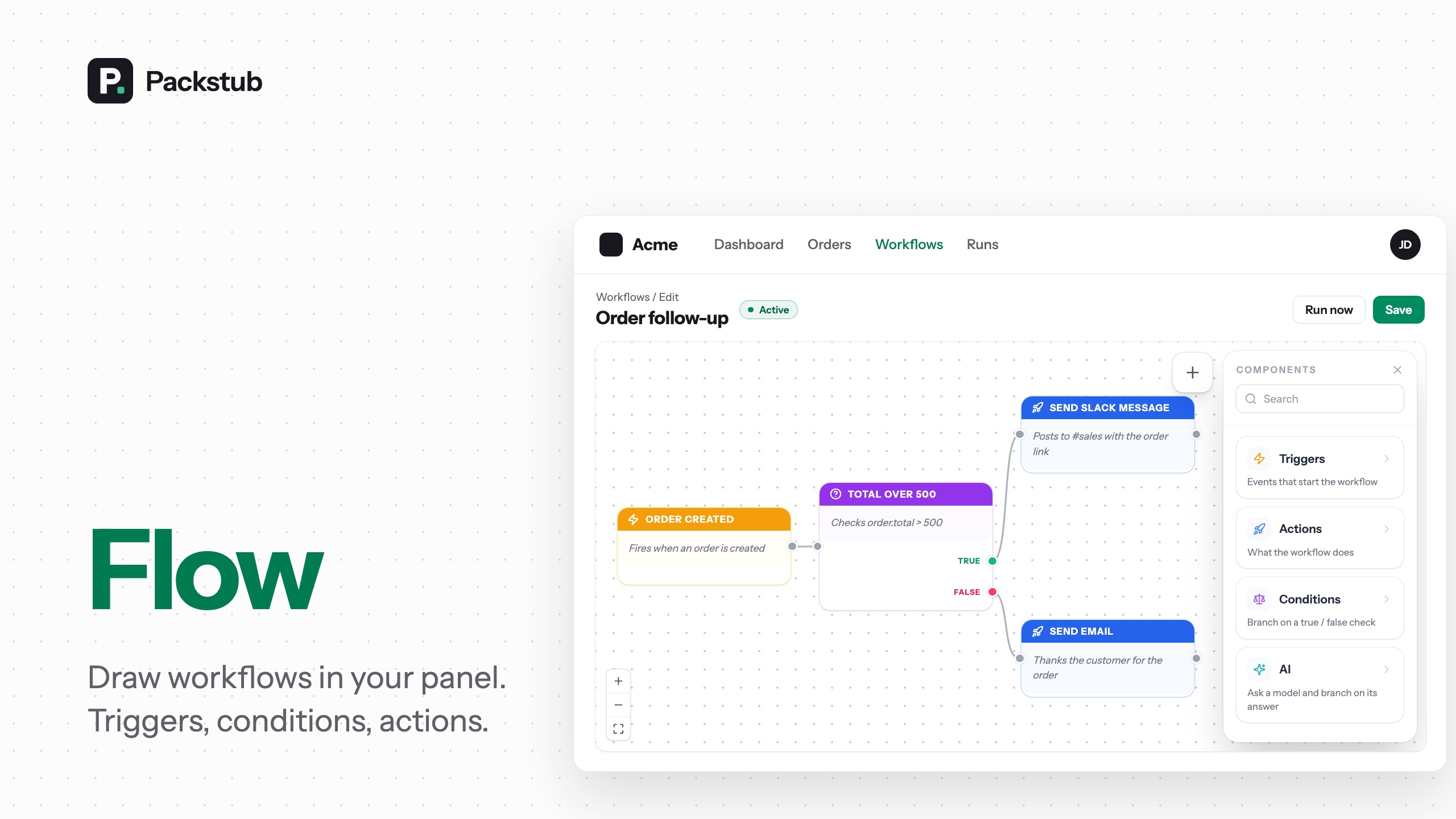
Visual workflow automations for Filament panels: triggers, conditions and actions drawn on a canvas, executed by a runner, optionally through your queue. Free and open source (MIT).
- Repository: github.com/packstub/filament-flow
- Packagist: packstub/filament-flow
- Support: GitHub issues
What you get
| Feature | What it means for you |
|---|---|
| Visual builder | A Workflows resource with a drag-and-drop canvas. Add triggers, conditions and actions from a sidebar, connect them, branch on true / false, and edit each node's settings in a slide-over built from Filament form components. |
| Triggers | Record created / updated / deleted (via the HasWorkflows trait, with "changed from / to" and dedup windows), a date on a record ("3 days before due_at"), spatie model-state transitions, user registered, any Laravel event, cron schedules (with catch-up), webhooks, a manual Run now or a Run workflow action on any resource, and calls from other workflows. |
| Conditions | Record attribute (including "changed from / to"), compare values (placeholders on both sides), multiple conditions (AND / OR) and time of day, with twenty operators. |
| Actions | Send email, Filament database notification, Slack, Discord, Teams, Telegram, SMS / WhatsApp (Twilio), HTTP request, create / update record, assign owner, add tag, transition state, find records + for each, wait, ask for approval, wait for signal, call workflow, write to log. Per-node retries, continue-on-error or an error branch; an on-failure workflow. |
| AI | Ask AI gets named fields back from a language model (with packstub/agents); Decide branches on a typed decision from Jev, TypeSafe's System One model — yes / no, one of your options, a score — with a Not sure branch for the close calls. |
| Placeholders | {{ model.name }}, {{ webhook.order.id }}, {{ event.carrier }}, {{ original.status }}, {{ changes.status }}, {{ model.url }}, {{ secrets.api_key }} — resolved from the payload in every text field. |
| Secrets | An encrypted store for tokens and webhook URLs, resolved only inside actions and masked in run logs; per tenant when you need it. |
| Multi-tenancy | In a panel with tenancy each team manages its own workflows, secrets, runs and approvals; global workflows run for everyone; a plan limit hook caps workflows per tenant. |
| Versions | Every change to a workflow is kept, with who saved it and what changed; compare and restore from the panel; runs pin the version they ran. |
| Templates, import & export | Start from a ready-made workflow (welcome series, order alert, dunning, SLA escalation, approval) or your own, or describe the workflow in a sentence and let a model draft it from your nodes (with packstub/agents); export a workflow as JSON and import it elsewhere, in the panel or from a seeder. |
| Runs | Every run is stored with status, trigger, record, payload summary, a step log (one row per step) and the error, shown in a Runs tab and on a cross-workflow Runs page with stats; a Test button for dry runs; packstub-flow:run and packstub-flow:prune commands; WorkflowStarted / WorkflowCompleted / WorkflowFailed / WorkflowDeactivated events. |
| Queue & scheduling | Inline or queued runs, Wait steps served by delayed jobs, and a packstub-flow:cron command registered with the scheduler for you. |
| Extensible | Subclass Trigger, Action or Condition, give it a form schema, and register it on the plugin, in the config or with Flow::register(). |
Guides
| Guide | What it covers |
|---|---|
| Installation | Requirements, the install command, the HasWorkflows trait, registering the plugin, queue and scheduler |
| Building workflows | The canvas: adding and connecting nodes, condition outputs, node settings, saving, and how a definition is stored |
| Triggers | Every built-in trigger, its settings, the payload it provides and how it fires |
| Actions | Every built-in action and its settings |
| Conditions | Every built-in condition and all operators |
| Decisions with Jev | The Decide action: a branch decided by TypeSafe's System One model — yes / no, one of your options, a score — with a Not sure branch under the confidence you ask for |
| Placeholders | Syntax, resolution, aliases, how values become text, what each trigger exposes |
| Secrets | The encrypted secrets store, {{ secrets.* }} in actions, masking in run logs |
| Approvals & signals | Pausing a run for a human decision or an external signal, the Approvals page, Flow::signal() |
| Templates, import and export | Starting from a template, describing a workflow in a sentence, the export file, importing in the panel or from a seeder, your own templates |
| Multi-tenancy | Tenant-scoped workflows, runs and secrets; global workflows; tenant resolution; plan limits |
| Runs | Statuses, the step log, Run now, console commands, retention, failure limits, events and the safety guards |
| Queue & scheduling | Sync versus queued runs, Wait steps, the cron command and scheduler registration |
| Extending | Writing and registering your own triggers, actions and conditions; dispatching from code |
| Configuration | Every config key, the fluent FlowPlugin API, custom models, tables, navigation and webhooks |
| Testing | Testing workflows in your application with Pest or PHPUnit |
At a glance
composer require packstub/filament-flow
php artisan packstub-flow:install
use Packstub\Flow\Concerns\HasWorkflows;

class Order extends Model
{
    use HasWorkflows;
}
use Packstub\Flow\FlowPlugin;

$panel->plugin(
    FlowPlugin::make()
        ->navigationGroup('Automation'),
);
Requirements
PHP 8.3+, Laravel 12 or 13, Filament 4 or 5.
These pages are published at packstub.dev/docs/filament-flow from the package's docs/ directory. Spotted a mistake? Open a pull request.