Configuration
Most settings live on the plugin so each panel can differ; a small config file holds the app-wide ones (tables, user model, environments).
The plugin API
use Filament\View\PanelsRenderHook;
use Packstub\AccountSwitcher\AccountSwitcherPlugin;

AccountSwitcherPlugin::make()
    // Feature toggles (bool or Closure)
    ->impersonation(true)
    ->linkedAccounts(true, userMenuItem: true)
    ->developerLogins(['admin@example.com'])

    // Authorization hooks
    ->canImpersonateUsing(fn (User $by, User $target): bool => $by->can('impersonate', $target))
    ->canSwitchUsing(fn (User $from, User $to): bool => ! $to->is_locked)

    // Sub-account creation
    ->createSubAccountUsing(fn (array $data, User $owner): User => User::create($data))

    // Where to land after any switch (string or Closure(Authenticatable): string)
    ->redirectTo(fn (User $user): string => $user->is_admin ? '/admin' : '/app')

    // Audit log on/off for this panel (defaults to the config value)
    ->logSwitches(true)

    // UI placement
    ->switcherRenderHook(PanelsRenderHook::USER_MENU_BEFORE)
    ->banner(position: 'bottom', style: 'dark')
    ->linkedAccountsPage(App\Filament\Pages\LinkedAccounts::class)
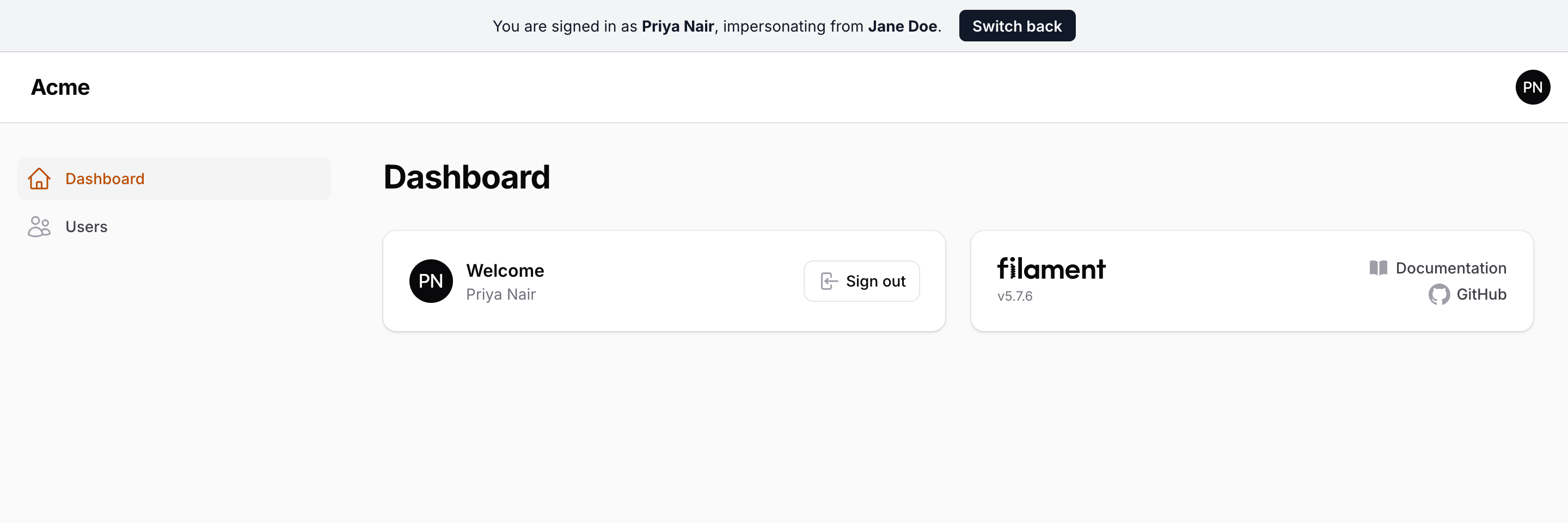
Banner placement
banner(position: 'top', style: 'light') renders the impersonation banner at the top of the page in the light style; the default is a dark banner at the bottom.
Feature toggles
| Method | Default | Effect when off |
|---|---|---|
impersonation() |
on | ImpersonateAction hidden, switch-back route not registered, banner not rendered, impersonate() throws |
linkedAccounts() |
on | No "Switch to" menu, no Linked accounts page or user menu item, switchToLinkedAccount() throws |
developerLogins() |
off | No buttons, developer-login route not registered |
Each accepts a Closure for runtime decisions, e.g. ->impersonation(fn (): bool => config('features.impersonation')).
Redirects
After a switch the plugin sends the browser to:
redirectTo()if set (string, or a closure receiving the target user), else- the current panel if the target user may access it, else
- the first panel the target user may access, else
- the current panel's URL (Filament will then show 403).
"May access" means canAccessPanel() for FilamentUser models, or "local environment" for other models — the same rule Filament's own Authenticate middleware applies.
The config file
php artisan vendor:publish --tag="packstub-account-switcher-config"
return [
    // The model linked accounts and the switch log point to.
    // null = config('auth.providers.users.model').
    'user_model' => null,

    // The connection both tables live on.
    // null = the user model's connection.
    'connection' => null,

    'tables' => [
        'linked_accounts' => 'linked_accounts',
        'account_switches' => 'account_switches',
    ],

    // Write an account_switches row for every switch.
    'log_switches' => true,

    'developer_logins' => [
        // Hard ceiling; the plugin toggle cannot override it.
        'environments' => ['local'],
    ],

    'banner' => [
        'position' => 'bottom', // 'top' | 'bottom'
        'style' => 'dark',      // 'dark' | 'light'
    ],
];
User model
Linked accounts and the switch log are relationships on one user model. It is resolved from user_model, falling back to auth.providers.users.model. Set it before running the migrations — they derive the foreign keys and the referenced table from it.
Connection
Both tables follow the user model's connection, so they always sit next to the users table. That is what a multi-database tenancy setup needs: a user model on a central connection keeps linked accounts and the switch log central, even while a request runs on a tenant connection. Set connection to pin them somewhere else. The migrations honour the same setting.
The switch log
Every switch writes one row to account_switches:
| Column | Meaning |
|---|---|
from_user_id |
Who was signed in (null for a developer login from the login page) |
to_user_id |
Who the session became |
reason |
impersonation, impersonation_ended, linked_account, developer_login (SwitchReason enum) |
panel, guard |
Where it happened |
ip_address, user_agent |
From the request |
created_at |
When |
Query it with the Packstub\AccountSwitcher\Models\AccountSwitch model (fromUser() / toUser() relationships), or build a Filament resource on it for an "Account activity" page. Turn logging off globally with log_switches or per panel with ->logSwitches(false).
Events
| Event | When | Payload |
|---|---|---|
Packstub\AccountSwitcher\Events\AccountSwitching |
After authorization passed, before the session changes. Throw to abort. | ?Authenticatable $from, Authenticatable $to, SwitchReason $reason |
Packstub\AccountSwitcher\Events\AccountSwitched |
After the session changed and the log row was written | same |
use Packstub\AccountSwitcher\Events\AccountSwitched;

Event::listen(AccountSwitched::class, function (AccountSwitched $event): void {
    if ($event->reason === SwitchReason::Impersonation && $event->to->is_vip) {
        Notification::route('mail', 'security@example.com')->notify(new VipImpersonated($event));
    }
});
The facade
Packstub\AccountSwitcher\Facades\AccountSwitcher proxies the AccountSwitcher service:
| Method | Purpose |
|---|---|
canImpersonate($by, $target) / impersonate($target) / isImpersonating() / impersonator() / stopImpersonating() |
Impersonation |
canSwitchToLinkedAccount($from, $to) / requiresPassword($from, $to) / switchToLinkedAccount($to, $password) |
Linked accounts |
developerLoginsEnabled() / developerLoginUsers() / developerLogin($user) |
Developer logins |
redirectUrlFor($user) / accessiblePanel($user) |
Panel resolution |
plugin() / userModel() |
Current panel's plugin instance; resolved user model class |
Denied operations throw Packstub\AccountSwitcher\Exceptions\AccountSwitchDenied (an AuthorizationException).
Translations and views
php artisan vendor:publish --tag="packstub-account-switcher-translations"
php artisan vendor:publish --tag="packstub-account-switcher-views"
Strings live under lang/vendor/packstub-account-switcher/{locale}/account-switcher.php; views under resources/views/vendor/packstub-account-switcher/ (menu, banner, developer-logins, pages/linked-accounts).