Styling
The stylesheet is plain CSS on Filament's colour variables (--gray-*, --primary-*, --danger-*) and follows the panel's theme and dark mode without compiling anything. The chart sits in a table-style container (.ps-gantt: the same ring, radius and shadow as a Filament table) with a toolbar, the chart and a footer with the bar count; every control in it (tabs, buttons, the search box, the date pickers, the selects, the funnel dropdown, the bar menu) is a Filament component, so the panel's theme styles it. Kanban, Gantt and Spreadsheet share the scheme: the same variables under each plugin's prefix (--ps-kanban-*, --ps-gantt-*, --ps-sheet-*), so one theme rule per plugin restyles all three alike. Restyle the chart with the --ps-gantt-* variables on .ps-gantt from your theme, prefixed so they win over the plugin's stylesheet:
.fi-body .ps-gantt {
    --ps-gantt-label-width: 18rem;   /* the sticky label column */
    --ps-gantt-radius: 0.75rem;
    --ps-gantt-bar-radius: 0.5rem;
    --ps-gantt-today: var(--danger-500);  /* the today line; the panel's primary colour by default */
    --ps-gantt-arrow: var(--gray-500);    /* dependency arrows, and the dashed late ones: */
    --ps-gantt-arrow-late: var(--warning-500);
    --ps-gantt-weekend: rgb(0 0 0 / 0.03);
    --ps-gantt-height: 40rem;        /* the most the chart grows to; pages fit it to the window by default */
}
| Variable | What it sets |
|---|---|
--ps-gantt-bg, --ps-gantt-surface, --ps-gantt-border, --ps-gantt-line |
Backgrounds, borders and grid lines (shared scheme). |
--ps-gantt-text, --ps-gantt-muted, --ps-gantt-soft, --ps-gantt-bar-text |
Text colours (the first three shared). |
--ps-gantt-ring, --ps-gantt-radius, --ps-gantt-shadow, --ps-gantt-outline, --ps-gantt-mono |
The container's focus ring and active-filter ring, its radius (0.75rem, a table's), shadow and 1px outline, the hint's monospace font (shared scheme). |
--ps-gantt-weekend, --ps-gantt-group, --ps-gantt-today, --ps-gantt-arrow, --ps-gantt-arrow-late |
Weekend shading, group rows, the today line, dependency arrows and the dashed late ones. |
--ps-gantt-label-width, --ps-gantt-height, --ps-gantt-bar-radius |
Sizes: the sticky label column, the most the chart grows to, the bars' corners. |
The container's parts are ps-gantt-toolbar (with ps-gantt-toolbar-start and ps-gantt-toolbar-end), ps-gantt-filters-inline / ps-gantt-filters-above / ps-gantt-filters-panel (by filtersLayout()), ps-gantt-scroll (the chart), ps-gantt-footer (the bar count) and ps-gantt-menu (the bar menu, in Filament's fi-dropdown-panel clothes).
Row height and pixels per day are numbers the script needs: set them in config/filament-gantt.php (row_height, px_per_day).
The chart is as tall as its rows, up to --ps-gantt-height; it scrolls past that.
Each bar carries its colour as --ps-bar; the stylesheet draws a tinted background, a solid start edge and the progress fill from it. A label too long for its bar is drawn just after it (ps-gantt-bar-outside), except in the compact layout, where the next bar of the lane may sit there. A bar narrower than its resize handles has none (ps-gantt-bar-narrow). Classes are prefixed ps-gantt- (ps-gantt-bar, ps-gantt-bar-milestone, ps-gantt-row-group…) for your own rules.
Dark mode
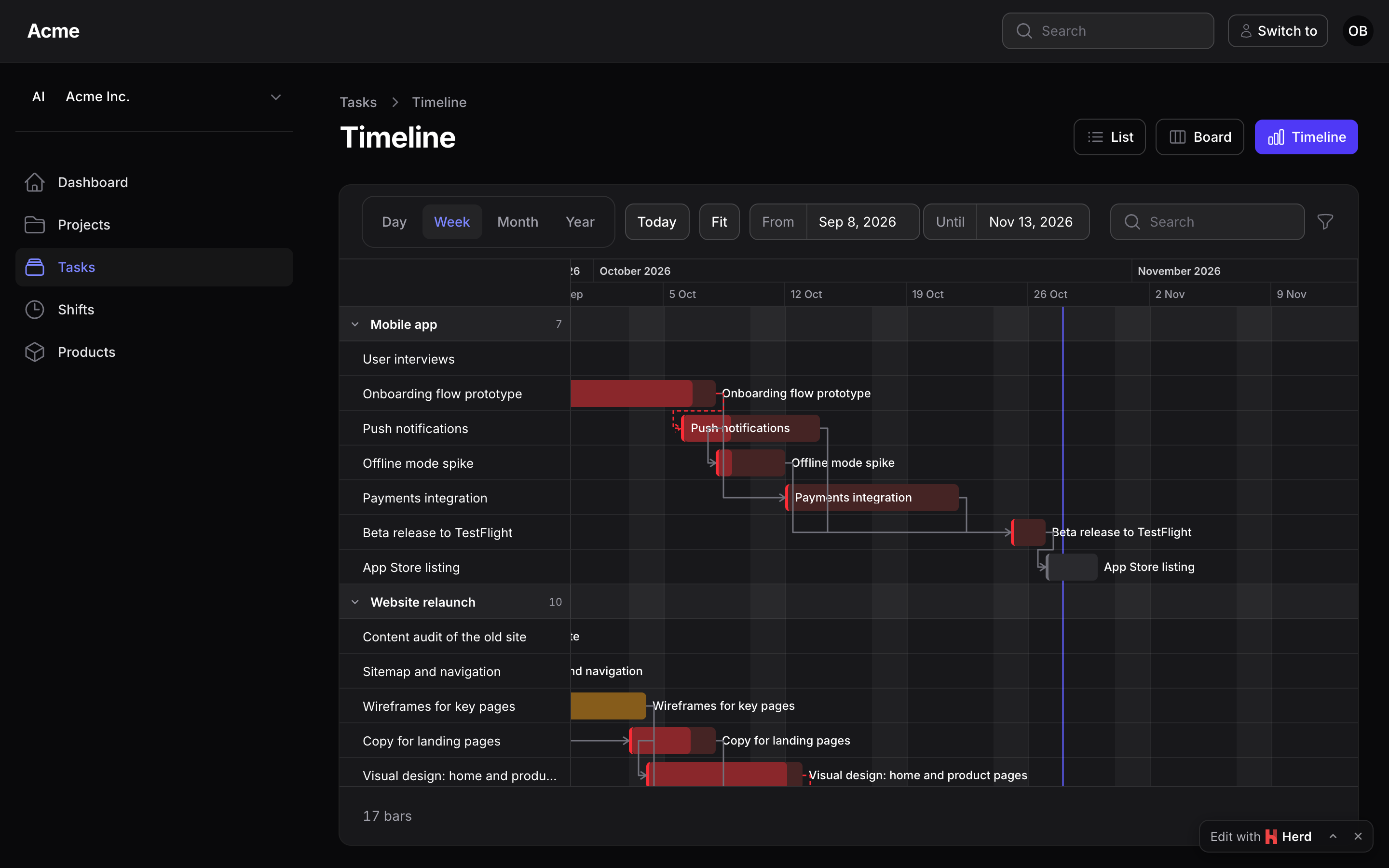
Handled: the variables are redefined under .dark .ps-gantt. Override them there for your own dark palette.
Right-to-left
The chart uses logical properties (inset-inline-start, margin-inline-end…) throughout, so under dir="rtl" the label column sits on the right, the axis runs right-to-left and a drag follows the pointer the right way.
Translations
Every string is in resources/lang/{en,ro,ru,de}/gantt.php. Publish them to change or add a language:
php artisan vendor:publish --tag=packstub-gantt-translations
Month and weekday names on the axis come from the browser's Intl in the panel's locale. The date formats of tooltips and messages are PHP formats from the language files (M j, Y in English, j. M Y in German, j M Y in Romanian and Russian), unless the config sets date_format and datetime_format for every locale. Counts use the language's plural forms.