Bars
A bar is a record with a start and an end. The definition names the attributes and how the bar looks; the browser draws it.
->start('starts_on')->end('ends_on')   // defaults: starts_at, ends_at
->label('title')                        // an attribute (an enum reads as its label), or fn (Task $task): string
->color('priority')                     // an attribute (a colour name, or an enum implementing HasColor), or a closure
->progress('progress')                  // 0–100, an attribute or a closure
Colours are names (gray, sky, amber, emerald, rose… or your panel's primary, success, warning, danger, info, or a colour you registered on the panel, brand), a Filament palette such as Color::Sky (its 500 shade is drawn), an enum implementing HasColor, or a CSS colour: #0ea5e9, rgb(…), hsl(…), oklch(…) and the other colour functions with plain values, var(--my-colour). Anything else is dropped and the bar uses the panel's primary colour: the value ends up in the bar's style, so a colour taken from user data (a project's colour field) cannot bring declarations of its own (red; position: fixed…), on the server or in the browser. Without one, the bars use the panel's primary colour.
Whole days and moments
The chart works in half-open ranges [start, end):
| Cast | A record from the 5th to the 7th | Drawn as |
|---|---|---|
date (whole days) |
starts_on = 2026-10-05, ends_on = 2026-10-07 |
three days, the 7th included |
datetime (moments) |
starts_at = … 09:00, ends_at = … 12:30 |
from 09:00 to 12:30 |
Whatever the browser does, the record is written back in the same convention: a whole-day record resized to end on the 9th gets ends_on = 2026-10-09. ->dateOnly() (or ->dateOnly(false)) overrides the detection for plain string columns. The tooltip follows the record too: whole days read as dates, moments as date and time.
Dates are handled as wall-clock times, never converted between zones, so a daylight-saving change never lengthens or shortens a bar (Time zones).
Milestones
A record with a null end is a milestone: a diamond at its start, movable but not resizable. A datetime record whose end equals its start is one too. To decide yourself, give milestone() an attribute or a closure:
->milestone('is_milestone')
->milestone(fn (Task $task) => $task->type === TaskType::Milestone)
Whole-day records with starts_on == ends_on are one-day bars, not milestones, unless milestone() says otherwise. A record milestone() flags keeps whatever end it has: when the diamond is dragged, its end moves by the same number of days.
The Bar shape
For anything beyond the three shortcuts, shape the bar in one closure. What it sets wins over label(), color() and progress():
use Packstub\Gantt\Bar;

->bar(fn (Task $task) => Bar::make()
    ->label($task->title)
    ->color($task->is_late ? 'danger' : $task->priority)
    ->progress($task->progress)
    ->tooltip($task->assignee?->name)
    ->url(TaskResource::getUrl('edit', ['record' => $task]))
    ->actions($task->is_locked ? ['view'] : ['view', 'edit', 'delete']))
| Method | What it does |
|---|---|
label() |
The text inside the bar, or just after it when it does not fit (beside a milestone). |
color() |
A colour name, a Filament palette, an enum implementing HasColor, or a CSS colour (see above). |
progress() |
0–100, a fill inside the bar; shown in the tooltip. |
tooltip() |
An extra line under the dates in the tooltip. |
url() |
Where a click goes when there is no click action; Ctrl/⌘-click always opens it in a new tab. Only http(s), mailto, tel and relative URLs are kept: a javascript: or data: value from a user-editable column is dropped, never followed. |
actions() |
The chart's bar actions this bar offers, by name (default: all); the server refuses the others for this bar too. Within these, a bar offers only the actions the user may run on its record (Actions). |
Bars are plain data drawn in the browser, so a chart of a few hundred bars is a few kilobytes of JSON rather than a few hundred Blade components. Eager-load what the closures touch (->query(fn () => Task::query()->with('assignee'))).
Dependencies
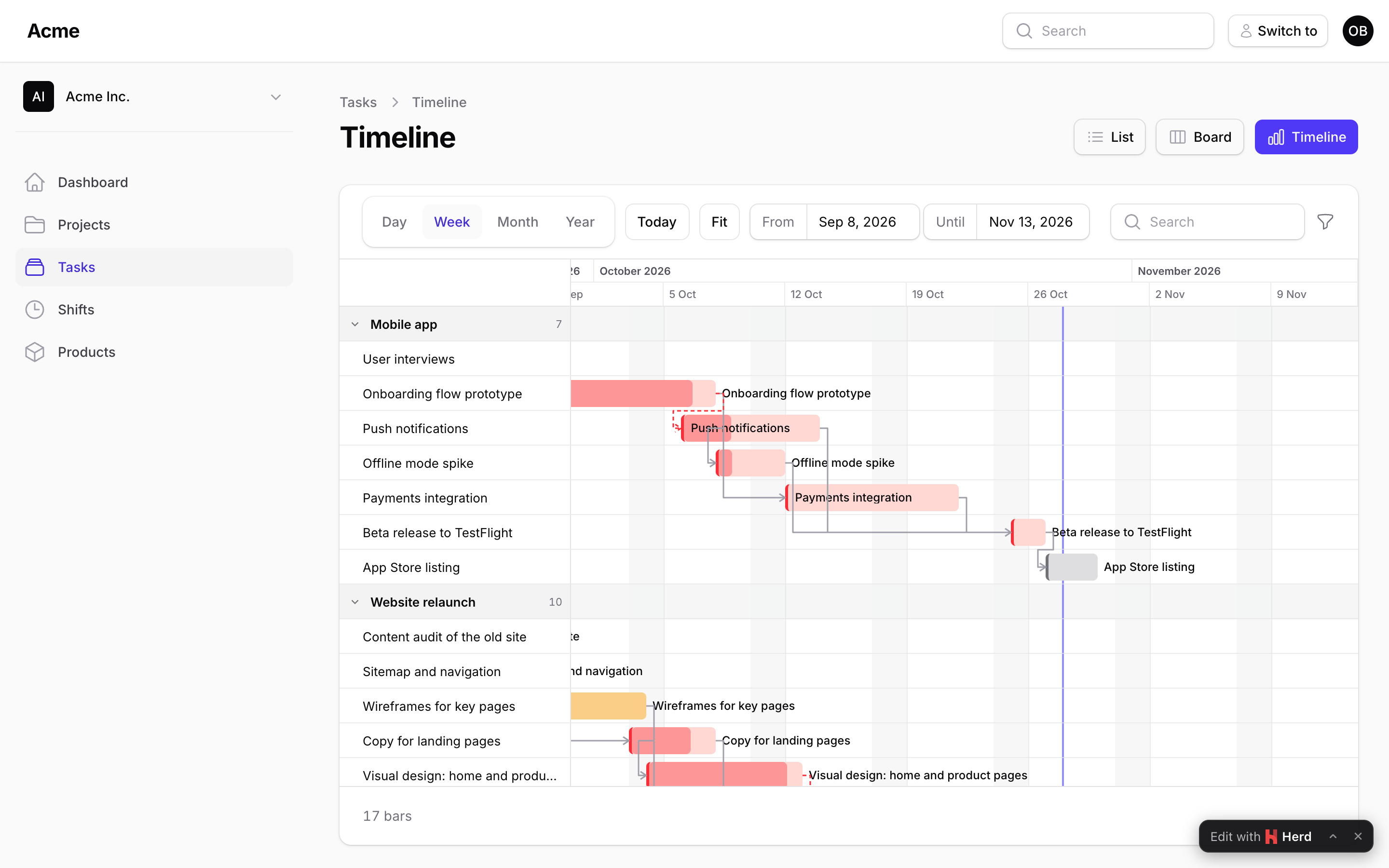
Tell the chart which bars a bar waits for and it draws an arrow from each predecessor's end to the bar's start (finish-to-start):
->dependencies('depends_on')     // a JSON or array column holding the predecessors' keys
->dependencies('predecessors')   // a relation to them (BelongsToMany, HasMany), eager-loaded with the bars
->dependencies(fn (Task $task) => $task->blockers->pluck('id'))   // or a closure returning keys or models
The arrows are drawn, not enforced: a successor that starts before its predecessor ends gets a dashed arrow in the danger colour, and nothing is rescheduled or refused. To refuse such a move, say so in canMove(). An arrow needs both bars on the chart: a predecessor outside the window, filtered out or in a folded group draws none. The arrows follow a bar while it is dragged. Their colours are --ps-gantt-arrow and --ps-gantt-arrow-late (Styling).
Order
Bars inside a group are ordered by their start; sortBy('priority', 'desc') orders them by another attribute. Records without a start are left out.